the alibi of animacy
for found musical expression mark and performances (2022)


Documents of realization by Null Point at Kleinhans Music Hall, occupied Seneca land
*
Program Note
content description: verbal descriptions of necropolitical violence, slavery, colonialism
Verbal indications in Western musical notation often known as tempo and expression marks are a telling if under-examined window into this music’s participation in ongoing Global North bio- and necropolitical regimes. The present work attends to how these marks construct enlist music in the differential apportioning of animacy. For interdisciplinary scholar Mel Chen, animacy “has been described variously as a quality of agency, awareness, mobility, and liveness.” Since the late eighteenth century, (in)animacy has functioned as a central measure in the operation of bio- and necropower, distinguishing Civilized/Primitive, Human/Animal, Spirit/Matter, and more. For numerous scholars, these politics institute irreducibly zero-sum logics in which the animation of one body is bound up with the de-animation of another. For instance, for Denise Ferreira da Silva, secular reason is reconciled with the self-determined (i.e. white) subject through the making of the outer-determined (i.e. racialized) subject. On the other hand, for Jason W. Moore, capitalism enables Society to accumulate capital through the degradation of entities positioned in Nature. Closer to aesthetic matters, for Kyla Schuller, sentiment is a particular kind of animacy which “distinguishe[s] civilized bodies as receptive to their milieu and able to discipline their sensory susceptibility and as such in possession of life and vitality that required protection from the threat posed by primitive bodies deemed to be impulsive and insensate, incapable of evolutionary change, whose existence was very close to running out of time.” As such, sentiment provides a way for excavating how the historical emergence of bourgeois concert music has been entwined with the contemporaneous beginnings of bio-/necropower.
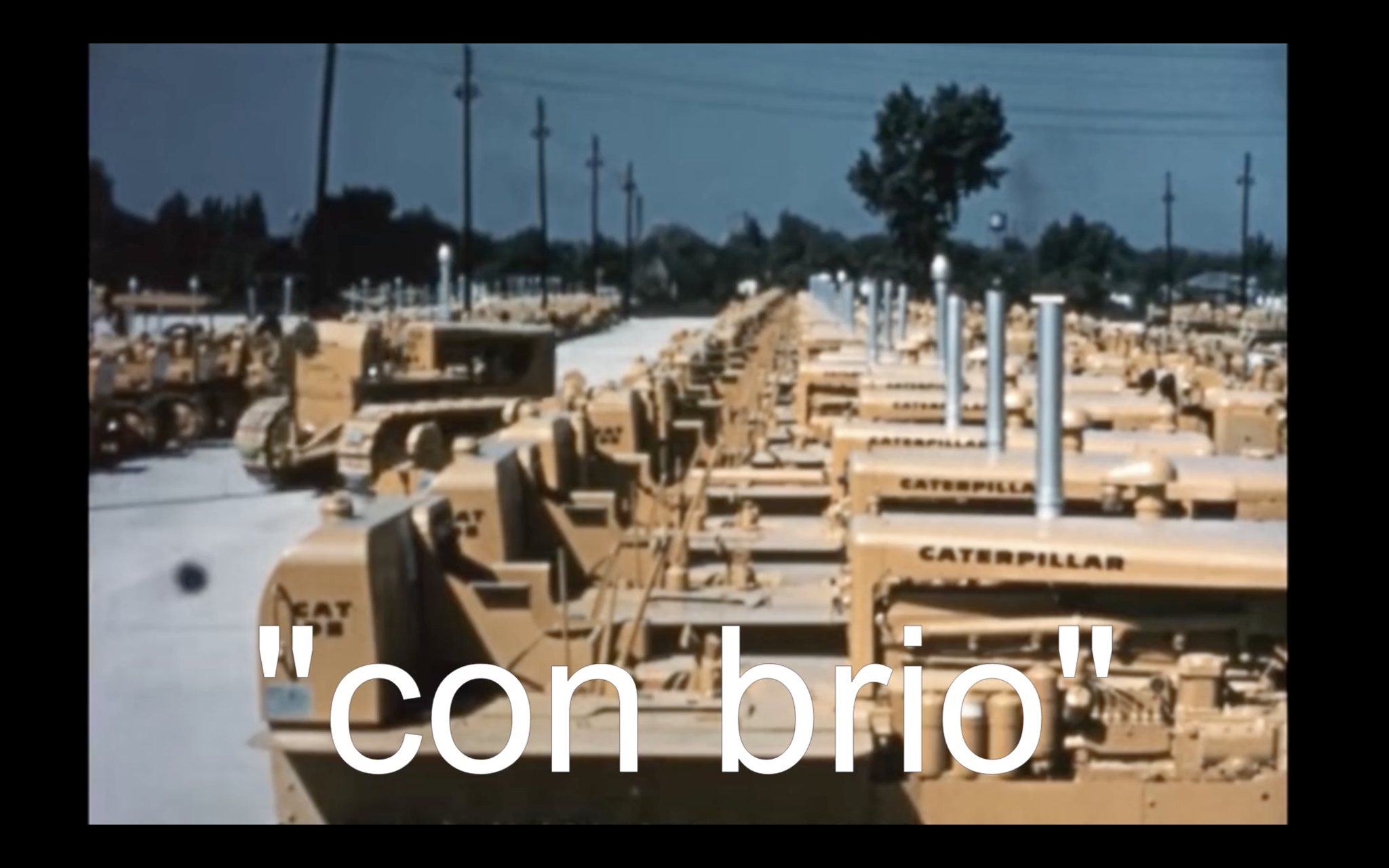
The present project isolates musical expression marks involved in the production of (in)animacy, specifically those with implications of sentiment and vitality. These notations are repurposed as annotations to (perpetrator-centered, non-pornotropic) documents of necropolitical de-animation, in order to foreground the irreducible linkage of animation and de-animation in colonial-racial capitalist modernity. This excavation ruptures imperial modernity’s compartmentalizations of animation from de-animation, and of aesthetic from political. In turn this protocol unearths the broader context in which musical expression marks become legible (i.e. “con brio” means be positioned as and perform whiteness), and also makes manifest the naturalizing effect of treating these marks as “purely musical.” As such, the endeavor here is not to speak about the experience of de-animation but instead to unearth the irreducibly violent relationality inherent in the position as being musically or otherwise animate(d), a position which is often unmarked, particularly in terms of its relationality.
The score was initially realized at Kleinhans Music Hall, in the occupied lands of the Seneca Nation:
“con brio” annotated six surveillance cameras affixed to the hall, apparatuses actively involved in:
- Protecting the sensitive subject of High Art, while criminalizing bodies read as insensitive.
- Through emphasis on a particular kind of evidence, flexing the muscle of the colonizer state (and its police/carceral apparatuses), while evacuating the sovereignty of the Seneca nation.
“vivace” annotated a street sign PORTER (named after General Peter Buell Porter, enslaver of at least five people), an infrastructure involved in:
- Memorializing the name of an enslaver, against the continuing white unknowing of racial slavery and its afterlives (Porter’s and more broadly). The literal raising of this name above the ground, against the violent engulfing of the enslaved into landscape, into Nature.
- Naming colonial state infrastructure, one that promotes the nation-state and capital, at the expense of the territorial integrity of the Seneca Nation.
- Enabling the spatial mobility of oil consumers and the capital accumulation of oil producers, against the (predominantly Global South and Indigenous) bodies and lands burdened with the costs of oil extraction and emission (see: carbon-centered transportation infrastructure).
The work has also been realized through video; a still of a realization by Megan Kyle is below.
 Colin Tucker [artist]